
Introduction
Collecting fees on time keeps a school running because staff salaries, school supplies, future planning and growth all depend on it. Late school fee payments will lead to constant phone calls, messages, and emails from the finance department to parents who have not cleared their dues. Most of the time, late payments happen for straightforward reasons: parents forget deadlines, lack information about the payment process and options, or cannot check their balance easily.
Why Do School Fee Payments Become Late?
Late payments are not always a result of unwillingness to pay. Here are some other common reasons why this happens:
- Parents forget payment deadlines, especially when fees are due on different dates.
- Fee information is unclear, so families are not sure how much to pay.
- Invoices are not delivered on time, which leaves little room to plan.
- Parents cannot easily check outstanding balances without calling the office.
- Limited payment methods make paying inconvenient.
- Manual payment processes create delays on both sides.
- A lack of timely reminders lets due dates slip by.
- Confusion about discounts or fee adjustments leads parents to wait for answers.
- Payment issues or failed transactions can stop payment from going through.
Because the cause is often the process and not parents, schools should improve how payments work before simply increasing follow-ups.
Set Clear School Fee Policies and Due Dates
Clear fee policies and well-defined due dates help parents understand their payment responsibilities and avoid confusion or fee delays. Communicating school policies from the beginning encourages timely payments, reduces disputes, and makes fee collection more organized.
Make Fee Schedules Easy to Understand
Inform parents about the tuition cost, payment frequency, and exact due dates. Let parents know about your school’s policies for late payments in plain and simple words. List any additional costs separately, so nothing comes as a surprise.
Communicate Policies Before the School Year Begins
Parents should be provided with the fee schedule well in advance, preferably at the time of admission. Keep the policies easy to find and provide them with step-by-step instructions on how to pay.
Keep Fee Information Consistent
The same figures must be reflected in every document, including invoices, parent portal, emails and messages because confusion arises from inconsistency and mixed information.
Give Parents Easy Access to Fee Information
Parents are far less likely to miss a payment when they can easily view tuition-related information and when it is due. Parents should be able to access:
- Their current balance at any time.
- Upcoming due dates so they can plan.
- Outstanding fees, clearly separated from paid ones.
- Previous payments for their own records.
- Invoices they can open and download.
- Receipts that confirm each payment.
- Discounts or adjustments, so the numbers make sense.
- Payment instructions that explain exactly how to pay.
A centralized parent portal gives families this information without the need for a call to the school office.
Use Automated Reminders Instead of Constant Follow-Ups
Automated reminders help schools keep parents informed about upcoming due dates and overdue fees without the need for constant manual follow-ups. By sending timely notifications through SMS, email, or app alerts, schools can reduce payment delays, save time, and ensure a smoother fee collection process.
Send Reminders Before the Due Date
Send a reminder several days prior to when the payment is due, so parents have enough time to decide. Keep your message brief and clear.
Send Due-Date Reminders
When the payment is due, inform parents about it in a timely manner. Mention the amount, due date, and method of payment, as well as any other necessary information.
Follow Up Automatically After the Due Date
If the payment remains open and unpaid, send a late notice informing parents about the outstanding amount along with the method of payment.
If this is done automatically, it helps reduce staff workload. An effective school fees management software will be able to perform all three steps without the need for staff to remember anything.
Make School Fee Payments Easier
A complicated payment process can delay payments even when parents are willing to pay. Schools should offer options that suit their students, such as:
- Online payments, so parents can pay from home.
- Credit and debit cards for quick, familiar checkout.
- Bank transfers for families who prefer them.
- Recurring payments, where they suit the school’s fee plan.
- Mobile-friendly payment options for parents on the go.
- Digital receipts that arrive right after payment.
Whatever you offer, clearly explain any processing fees or related policies.
Use a Parent Portal to Improve Fee Payment Visibility
A parent portal gives families easy access to fee details, payment history, and upcoming due dates in one place. By keeping parents informed, schools can encourage timely payments and reduce confusion around fee management.
Let Parents View Outstanding Fees
A parent portal allows parents to view current balances, upcoming payments, and full payment history in one place.
Allow Parents to Make Payments
When parents can reach payment options directly from their account, they rarely need to contact the finance office.
Provide Payment Confirmations
Receipts and updated payment records give parents confidence that their payment has been received, which prevents unnecessary confirmation calls from them.
Track and Manage Late Payments More Efficiently
Stay on top of your school’s finances by monitoring the following key payment details, so you can follow up with parents on time, when needed.
- Outstanding balances across the school.
- Overdue invoices that need attention.
- Payment history for each family.
- Days overdue, to judge how urgent each case is.
- Partial payments, so part-paid accounts are not missed.
- Failed payments that need a second attempt.
- Payment reminders already sent.
- Payment status by student or class.
With this view, administrators can focus on genuine overdue accounts instead of checking every student one by one. Fee management software keeps all of this in one dashboard.
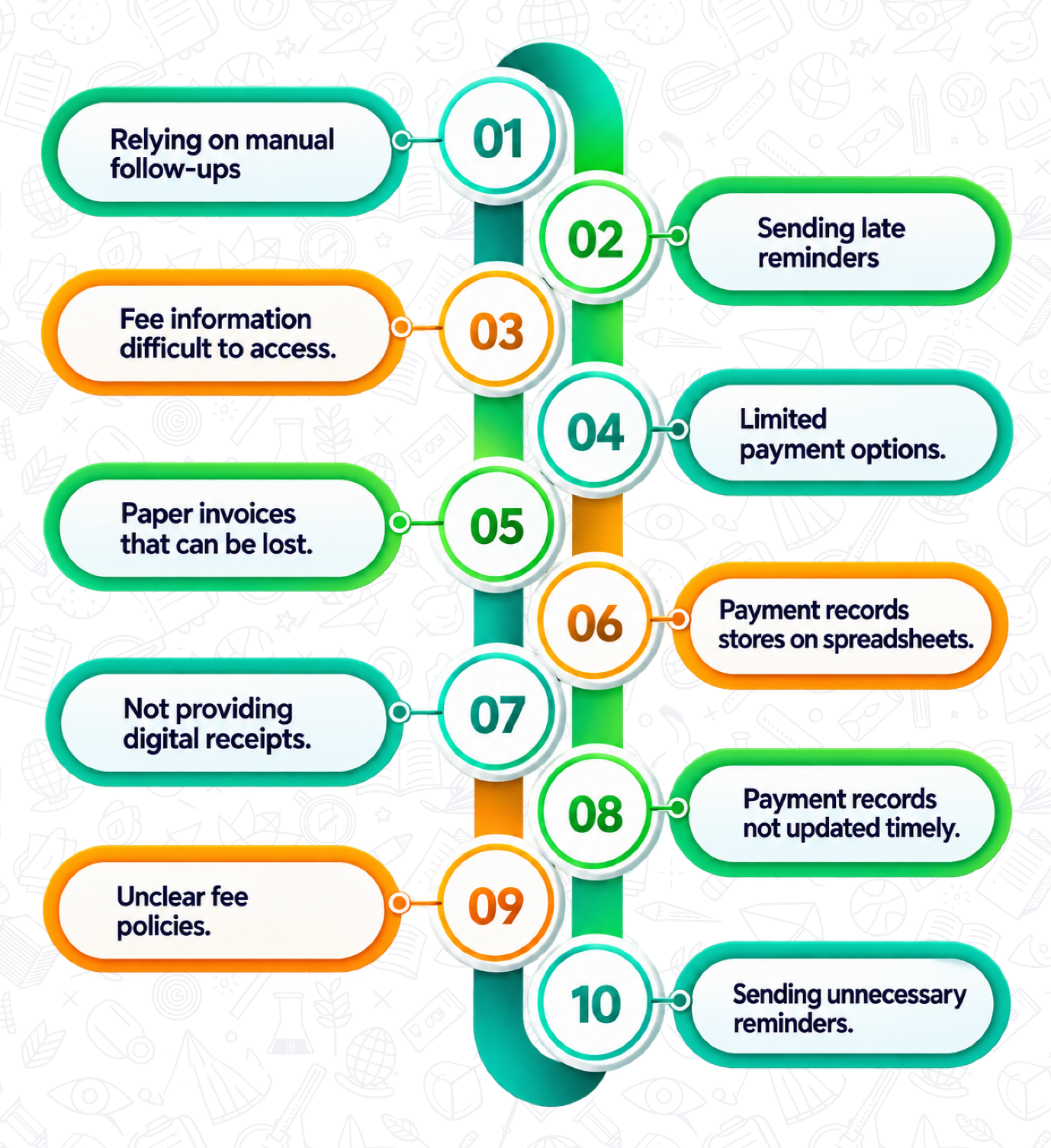
Common Mistakes That Increase Late Fee Payments
Late fee payments often result from more than just parents forgetting due dates. Identifying the actual reason is the first step toward improving tuition fee collection.
Some common mistakes include:
How Technology Can Reduce Late School Fee Payments
Technology simplifies fee collection through automation, making payments more convenient for parents. With the right school management system, schools can reduce payment delays, improve fee collection, and maintain better financial control.
Automate Fee Invoices and Reminders
A school fee management software can create invoices, schedule reminders, send overdue notices, and confirm payments automatically.
Centralize Fee and Student Information
When student records, parent details, fee records, and payments are connected, administrators see a complete picture of every account without switching between files.
Use Reports to Identify Payment Patterns
Reports can show which families pay late repeatedly, how payments differ by month or term, and which problems come up most often. This data can be used to improve fee policies.
How Muntazim Can Help Schools Manage Fee Payments
Muntazim is a cloud-based school management system, built for Islamic schools that also covers Weekend schools, Maktabs, and Hifz programs. Its fee module is made flexible to fit all schools with different fee structures. As a fee management software for schools, it lets administrators generate invoices, track overdue payments, send automated reminders to parents, and get real-time financial insights.
Parents get access to their personal accounts where they can view payment history and receipts as well as make on-the-spot payments. Since the fee records are linked to parents’ and students’ information, there is no need to input the same information twice, and families can find answers without calling the office. Schools can also control who sees financial data through user access settings.
Frequently Asked Questions (FAQs)
Usually because of forgotten deadlines, unclear fee details, limited payment options, or difficulty checking balances.
By setting clear policies, sharing balances with parents, sending automated reminders, and offering easy payment methods.
A reminder before the due date, one on the due date, and an automatic follow-up after it is a good, simple pattern.
Yes. Early reminders give parents time to arrange payment, so fewer accounts become overdue.
It lets parents see balances, due dates, invoices, and receipts on their own, without contacting the office.
Online payments, cards, and bank transfers are common, along with mobile-friendly options and digital receipts.
Yes. Most school fee management software can send scheduled reminders and overdue notices automatically.
Send a clear overdue notice with the amount and payment options, then follow your published policy consistently.
By recording payments right away and using fees management software that shows paid, partial, and unpaid balances.
Conclusion
Reducing late school fee payments is not just the result of increasing the number of reminders. This practice requires more than that; for example, fee policies, easy access to balances, automation of reminders, convenient payment methods, parent portals, centralized fee tracking, and reporting.
If it is easy for the parents to comprehend, recall, and make the payments, then the administrative staff will have to do significantly less follow-up work. Review your current fee workflow, find the major causes of delays, and fix those first.
Related Sources
School Tuition & Fee Management: The Complete Guide for Administrators
Top Features to Look for in a Tuition Management System for Islamic Schools
Modernizing Fee Collection: Secure Payment Solutions for Islamic Schools
Aamnah Farhan
Aamnah is a Content Marketing Professional specializing in school management software, student information systems, and Islamic school challenges & solutions. She develops research-driven content that helps schools and educational institutions streamline operations, adopt digital solutions, and stay informed about the latest trends in education and school management.