Introduction
For a small school, evaluating school management software cost means looking beyond the lowest figure shown on a pricing page. What matters is understanding what the price includes and how it scales as enrollment increases. In 2026, schools can choose from several pricing structures, including per-student charges, flat monthly fees, and free tiers with meaningful limitations. The lowest advertised price is not necessarily the most economical, since support and premium modules are included.
This guide explains the major pricing models, the factors that influence cost, real examples for smaller enrollments, and how Muntazim’s pricing plans compare.
How Much Does School Management Software Cost?
Average School Management Software Pricing
Current 2026 industry guidance puts the typical cost of most systems at roughly $2 to $15 per student per month. However, flat-rate, free, and module-based plans are also available.
A school with fewer than 100 students could spend a few hundred dollars annually on a flat plan, while a growing institution using several add-on modules might spend a few thousand dollars per year. There is no universal price; the final cost depends on enrollment, the depth of features, and the vendor’s billing structure.
What Determines the Cost?
Several factors can increase or reduce the overall price:
- Number of students enrolled
- Number of teachers and administrator accounts
- Features included in the plan
- Number of schools or campuses managed
- Payment processing requirements
- Parent and teacher mobile apps
- Data migration from an old system
- Customer support level
- Customization and third-party integrations
Common School Management Software Pricing Models
Per-Student Pricing
Under this model, schools are charged a monthly or annual amount for each student. Because the fee rises with enrollment, this approach can be appealing to smaller institutions whose costs remain proportional to their size.
Flat-Rate Pricing
A school pays a fixed amount for a defined enrollment range, regardless of its exact student count. For very small schools, this can make budgeting easier and more predictable.
Freemium or Free Plans
Free plans generally provide only basic student records or limited communication features. Schools may need to upgrade to paid plans for functions such as attendance automation, fee collection, or higher enrollment limits. It is important to check what the free tier leaves out.
Custom or Enterprise Pricing
Larger schools, multi-campus networks, and institutions requiring advanced integrations commonly receive a custom quote instead of choosing from a published pricing tier.
School Management Software Cost for Small Schools
What Should a School With 1–75 Students Expect to Pay?
At this enrollment level, flat-rate plans are often common and can be the most economical choice. A per-student charge for a very small roster may cost more than a straightforward fixed fee.
What About Schools With 76–150 Students?
When enrollment moves into this range, the effect of per-student pricing on the monthly bill becomes more noticeable. Schools should compare a flat tier with a per-student plan to determine which option is less expensive for their actual headcount.
How Does Pricing Change as Enrollment Grows?
Per-student prices generally fall as schools move into higher enrollment tiers, rewarding larger scale. Before enrollment reaches a pricing threshold, review how the vendor structures each tier.
Example Annual Cost Calculation
Consider a school with 100 students using a $0.93 per-student monthly rate:
- Monthly cost: of Students × Monthly Rate per Student (100 × $0.93 = $93)
- Annual cost: Monthly Cost × 12 ($93 × 12 = $1,116)
- Cost per student, per year: Annual Cost divided by No. of Students (about $11.16)
- Potential additional fees: payment processing, SMS notifications, or premium modules, depending on the vendor
Muntazim Pricing for Small Schools
Muntazim uses enrollment-based tiers instead of placing pricing behind a “contact sales” form. This allows administrators to estimate their expected costs before making a decision.
Muntazim Lite Pricing Plan
| Student Enrollment | Standard Pricing |
|---|---|
| 1–75 students | $100 flat rate |
| 76–150 students | $1.25/student/month |
| 151–300 students | $0.90/student/month |
| 301–500 students | $0.65/student/month |
| 501+ students | $0.45/student/month |
Confirm the latest rates on the Muntazim pricing page before preparing a budget, since pricing plans can vary.
What Is Included in Muntazim's Pricing?
Rather than offering only a basic student list, the plans are designed around a complete administrative suite that includes:
- Student management and admissions
- Fee management and attendance
- Parent app and parent/teacher portals
- Communication tools
- Lesson planner and assignments
- Grading and report cards
- User management and data import
Muntazim’s official feature and pricing pages list these capabilities across its plans.
Want to know what your school would pay?
Receive a quick answer based on your school’s requirements.
What Are the Hidden Costs of School Management Software?
The advertised subscription price should not be the only figure you use when comparing platforms. Look out for costs such as:
- Setup fees
- Data migration charges
- Payment processing fees
- Premium modules sold separately
- Mobile app fees
- Charges for additional administrator accounts
- Training costs
- Customization requests
- Integration costs with existing tools
- Support fees for anything beyond basic tickets
How to Calculate the Total Cost of Ownership
Use a simple formula to make software comparisons more accurate:
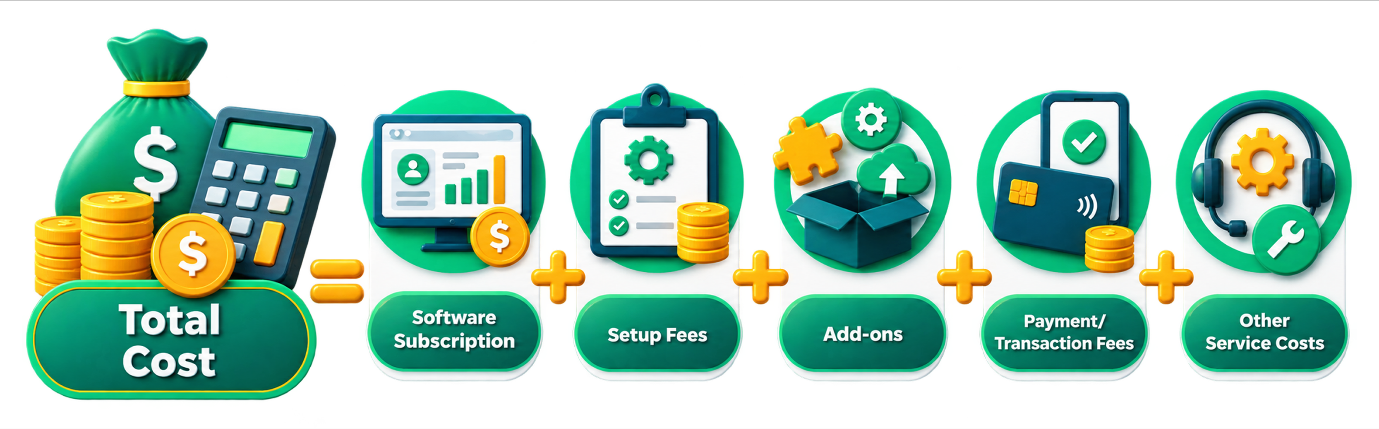
Applying this calculation to every vendor, instead of comparing headline subscription prices alone, usually gives a clearer picture of which option is genuinely more affordable over a full year.
What Features Should Small Schools Get for Their Budget?
Essential Features
At minimum, a school’s budget should include:
- Student Information System: a central place for enrollment details, contact info, and academic records, so nothing lives in scattered spreadsheets.
- Attendance Tracking: daily attendance logged digitally, with visibility into patterns like frequent absences.
- Fee Management: online fee collection and invoicing that cuts down on manual bookkeeping and late-payment follow-ups.
- Parent Communication: a simple way to send updates, announcements, and reminders without relying on phone trees or group texts.
- Admissions: a structured intake process for new student applications, from inquiry to enrollment.
- Basic Reporting: enough visibility into enrollment, attendance, and fees to make every day administrative decisions.
Valuable Features as Your School Grows
As enrolment increases, these become more valuable:
- Lesson Planning: a shared space for teachers to organize daily and weekly lesson content.
- Assignments: digital assignment creation and submission, reducing paper handling.
- Grading: standardized grade entry and report card generation across classes.
- Parent App: real-time updates on a mobile device instead of email or paper notices.
- Teacher Portal: a dedicated space for teachers to manage their own classes, grades, and communication.
- Multi-Campus Management: one system across multiple campuses or programs, useful once a school scales beyond a single site.
- Advanced Reporting: deeper analytics on enrollment trends, attendance patterns, and financial performance.
Prioritize what your school will actually use rather than paying upfront for enterprise functionality you won’t touch for years. A small school with 60 students rarely needs multi-campus tools but will feel the difference from solid attendance and fee management on day one.
How to Choose Affordable School Management Software
Compare the Total Cost, Not Just the Monthly Price
A low monthly rate can be misleading if setup fees, per-transaction charges, or premium modules aren’t included. Add up the subscription, one-time fees, and any recurring extras for a full year before comparing two vendors side by side. That’s the number that actually reflects what you’ll spend.
Check What Features Are Included
Pricing tiers don’t always include the same things. Some plans bundle attendance, fees, and communication together, while others charge extra for a parent app or lesson planner. Get a full feature list per tier, not just a summary, so you know exactly what you’re paying for at each price point.
Ask About Additional Fees
Before signing up, ask directly about setup costs, data migration charges, payment processing rates, and fees for extra administrator accounts. Vendors don’t always list these upfront, and they can add hundreds of dollars to the first-year cost even on an affordable plan.
Consider Your Expected Enrollment Growth
A price that works well for 50 students may look very different at 150. Check how the vendor pricing tiers scale, and pick a platform that stays affordable and keeps the features you need. As your enrollment grows over the next few years, not just this one.
Test Ease of Use Before Committing
A feature-rich platform isn’t worth much if teachers and staff find it confusing. Request a free trial or demo and have a few staff members actually use it, enter attendance, send a message, pull a report, before making a decision based on a features list alone.
Check Data Migration and Support Options
Check Data Migration and Support Options
Moving from spreadsheets or an old system to a new platform can be disruptive if migration isn’t handled well. Ask how student records get transferred, how long it takes, and what support looks like afterwards – live chat, phone, email – since ongoing support quality matters as much as the initial price.
School Management Software Cost Comparison
Compare the Top Platforms for Small Schools
| Platform | Pricing Model | Starting Price | Student Limit | Key Features | Best For | Source |
|---|---|---|---|---|---|---|
| Muntazim | Flat-rate + per-student tiers | $100/month flat | 1–75 students | Admissions, fees, attendance, parent/teacher portals, lesson planner | Islamic schools, weekend programs, growing enrollments | https://muntazim.com/ |
| SchoolCues | Per-student | $75/month (12-month school year) | - | Admissions, SIS, alumni management, communications | Very small, budget-conscious schools | https://www.schoolcues.com/ |
| QuickSchools | Per-student | $0.99 per student/month | Unlimited users | Student tracking, teacher tracking, attendance, admissions, fee tracking | Schools wanting a simple, low-cost entry point | https://www.quickschools.com/ |
| AlifCloud | Free tier + per-student | Free forever up to 30 students; $1.49/student/month above that | 30 students | Quran & Arabic tracking, online registration, mobile app, quizzes, all included on every plan, no add-ons | Small dugsis/maktabs that want to start free and outgrow the plan later | https://www.alifcloud.com/ |
Pricing shown reflects publicly available vendor information as of this writing and can change, confirm current rates directly with each provider before deciding.
Which Option Offers the Best Value?
The best value is not necessarily the platform with the smallest number on its pricing page. Consider the price together with feature depth, ease of use, and the platform’s ability to scale smoothly as enrollment grows. Choosing the cheapest listed rate may not be the best decision if it no longer suits the school two years from now.
Want a side-by-side comparison to see what suits your school?
Frequently Asked Questions (FAQs)
For most small schools, costs range from a flat fee of around $75–$150 a month to approximately $1–$2 per student per month, depending on the provider and the features included.
Per-student pricing commonly falls between about $0.30 and $2 or more per student, per month. As enrollment grows, lower per-student rates typically become available.
Some providers have limited free tiers, but these plans generally restrict features such as attendance automation or fee collection. As a result, most schools eventually move to a paid plan.
Budget-focused vendors may offer entry-level per-student plans starting below $1 per student per month, although the range of features available at that price varies.
Yes. Setup fees, data migration charges, payment processing fees, and premium modules are common additional expenses and may not be included in the headline subscription price.
For most schools, the time saved through attendance management, fee collection, and parent communication can outweigh a modest monthly fee when compared with manual, paper-based processes.
Muntazim Lite’s current pricing begins at $100/month flat for schools with 1–75 students. At 501+ students, per-student pricing can be as low as $0.45 /student per month; standard rates.
Conclusion
Across all four pricing approaches- per-student, flat-rate, freemium, and custom- the key point remains the same: software cost is only one part of the overall picture. Features, scalability, and hidden fees also matter.
When a small school compares platforms, it should consider total cost of ownership rather than only the number displayed on a pricing page. It is also useful to consider where enrollment is likely to be in two or three years, not only where it stands today.
Muntazim’s Enrollment-based tiers and full administrative feature set provide a straightforward option for schools comparing their next management system with what they currently spend on manual processes or an outdated platform.
Ready to see what your school could save?
Compare your current school management costs with Muntazim's pricing and see which option fits your school.
Related Resources
Islamic School Management Software Compared: SchoolCues vs Muntazim vs Alif Cloud
Why Small Schools Need a Student Information System
Best School Management Software in USA: Features, Pricing & Reviews
Aamnah Farhan
Aamnah is a Content Marketing Professional specializing in school management software, student information systems, and Islamic school challenges & solutions. She develops research-driven content that helps schools and educational institutions streamline operations, adopt digital solutions and stay informed about the latest trends in education and school management.